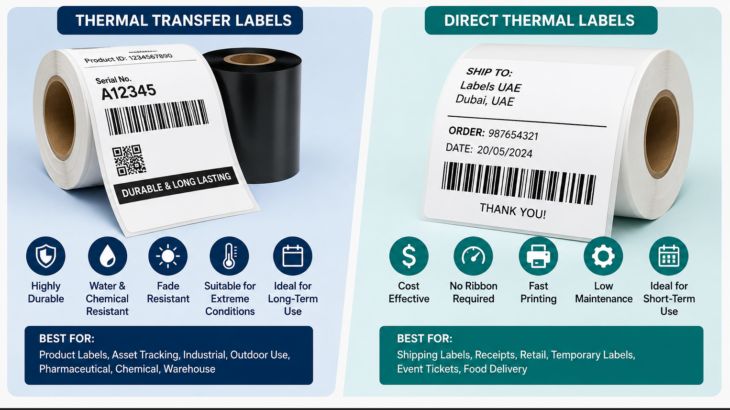
Choosing the right label printing method is important for any business that relies on product identification, inventory management, shipping, or barcode tracking. Two of the most common options are thermal transfer labels and direct thermal labels. Although they may look similar, they are designed for different purposes.
Understanding the difference between these label types can help you save money, improve efficiency, and ensure your labels remain readable for as long as you need them.
In this guide, we’ll explain how both printing methods work, compare their advantages and disadvantages, and help you decide which option is best for your business.
What Are Thermal Labels?
Thermal labels are printed using a thermal printer instead of traditional ink or toner. These printers use heat to create text, images, and barcodes on specially designed label materials.
There are two main types of thermal printing:
- Thermal Transfer Printing
- Direct Thermal Printing
While both use heat, the printing process and durability are very different.
What Are Thermal Transfer Labels?
Thermal transfer labels are created using a thermal printer along with a ribbon coated with wax, resin, or a combination of both. The printer applies heat to the ribbon, transferring the ink onto the label surface.
This process produces highly durable labels that resist fading, moisture, chemicals, scratches, and extreme temperatures.
Advantages of Thermal Transfer Labels
- Long-lasting print quality
- Excellent barcode readability
- Resistant to water and chemicals
- Suitable for outdoor use
- Handles heat and cold well
- Available in many materials and finishes
- Ideal for permanent labeling
Common Applications
Thermal transfer labels are widely used for:
- Product labels
- Asset tracking
- Warehouse inventory
- Manufacturing
- Pharmaceutical products
- Chemical containers
- Retail shelf labels
- Industrial equipment
- Laboratory samples
What Are Direct Thermal Labels?
Direct thermal labels use heat-sensitive paper that changes color when exposed to heat from the printer. Unlike thermal transfer printing, no ribbon is required.
Because the label itself reacts to heat, printing is faster and the printer requires fewer supplies.
However, these labels are more sensitive to sunlight, heat, moisture, and friction.
Advantages of Direct Thermal Labels
- No ribbon required
- Lower operating costs
- Faster printing
- Simple printer maintenance
- Ideal for short-term use
- Cost-effective for high-volume printing
Common Applications
Direct thermal labels are commonly used for:
- Shipping labels
- Courier labels
- Retail receipts
- Temporary identification labels
- Event tickets
- Food delivery labels
- Visitor badges
- Logistics tracking
Key Differences Between Thermal Transfer and Direct Thermal Labels
Although both technologies use heat, they perform differently depending on the environment and label lifespan.
Printing Method
Thermal Transfer
Uses a ribbon that transfers ink onto the label.
Direct Thermal
Prints directly onto heat-sensitive paper without using a ribbon.
Durability
Thermal transfer labels are designed to last for years. They resist fading and remain readable even in challenging environments.
Direct thermal labels usually last only a few months before fading, especially when exposed to sunlight or heat.
Cost
Direct thermal printing has a lower initial operating cost because ribbons are not needed.
Thermal transfer printing involves ribbon replacement but offers greater durability, reducing replacement costs for long-term labels.
Print Quality
Both methods produce sharp barcodes and text.
However, thermal transfer labels maintain their quality much longer, making them suitable for permanent applications.
Environmental Resistance
Thermal transfer labels perform much better in:
- Outdoor environments
- Cold storage
- Freezers
- High temperatures
- Moist conditions
- Chemical exposure
Direct thermal labels perform best indoors and in controlled environments.
When Should You Choose Thermal Transfer Labels?
Thermal transfer labels are the better option if your labels need to remain readable for months or years.
Choose thermal transfer labels if you need:
- Durable product labels
- Long-term barcode labels
- Asset management labels
- Equipment identification
- Industrial labels
- Outdoor labeling
- Waterproof labels
- Chemical-resistant labels
Businesses in manufacturing, healthcare, logistics, automotive, electronics, and pharmaceuticals often rely on thermal transfer printing because of its long-lasting performance.
When Should You Choose Direct Thermal Labels?
Direct thermal labels are ideal for short-term applications where labels are used quickly and do not need to last for years.
Choose direct thermal labels for:
- Shipping labels
- Courier services
- Warehouse dispatch
- Retail receipts
- Temporary inventory labels
- Event passes
- Food delivery packaging
If the label will only be used for a few days or weeks, direct thermal printing is usually the most economical choice.
Which Industries Use Each Type?
Industries Using Thermal Transfer Labels
- Manufacturing
- Automotive
- Healthcare
- Pharmaceuticals
- Electronics
- Food production
- Chemical companies
- Asset management
- Warehousing
Industries Using Direct Thermal Labels
- E-commerce
- Courier companies
- Retail stores
- Supermarkets
- Hospitality
- Restaurants
- Shipping companies
- Distribution centers
Factors to Consider Before Choosing
Before selecting your labels, ask yourself these questions:
How long should the label last?
If your labels need to remain readable for years, thermal transfer is the better option.
Will the label be exposed to sunlight?
Direct thermal labels fade when exposed to UV light.
Will the label face moisture or chemicals?
Thermal transfer labels offer much better protection.
Is cost your biggest concern?
Direct thermal labels reduce printing costs because ribbons are not required.
Do you print high volumes every day?
Both methods support high-volume printing, but your choice depends on label lifespan rather than print speed.
Thermal Transfer vs Direct Thermal: Quick Comparison
| Feature | Thermal Transfer | Direct Thermal |
|---|---|---|
| Ribbon Required | Yes | No |
| Print Durability | Excellent | Moderate |
| Fade Resistance | High | Low |
| Moisture Resistance | Excellent | Limited |
| Heat Resistance | Excellent | Poor |
| Outdoor Use | Yes | Not Recommended |
| Long-Term Storage | Excellent | Limited |
| Operating Cost | Medium | Lower |
| Best For | Permanent Labels | Temporary Labels |
Which Option Is Better?
There is no single answer because both technologies are designed for different purposes.
If your labels need to survive harsh environments, remain readable for years, or resist chemicals and moisture, thermal transfer labels are the best investment.
If you print thousands of shipping labels every day that only need to last during transportation, direct thermal labels provide a fast and cost-effective solution.
Many businesses actually use both systems depending on the application.
Conclusion
Choosing between thermal transfer labels and direct thermal labels depends on how your labels will be used. While direct thermal labels are affordable and ideal for short-term applications like shipping and receipts, thermal transfer labels provide exceptional durability for long-term identification, inventory management, and industrial use.
By understanding the strengths of each printing method, businesses can improve efficiency, reduce replacement costs, and ensure barcodes and product information remain clear and readable throughout the label’s lifespan.
Whether you’re managing a warehouse, shipping products worldwide, or labeling retail goods, selecting the right thermal label solution will help your operations run more smoothly and professionally.

